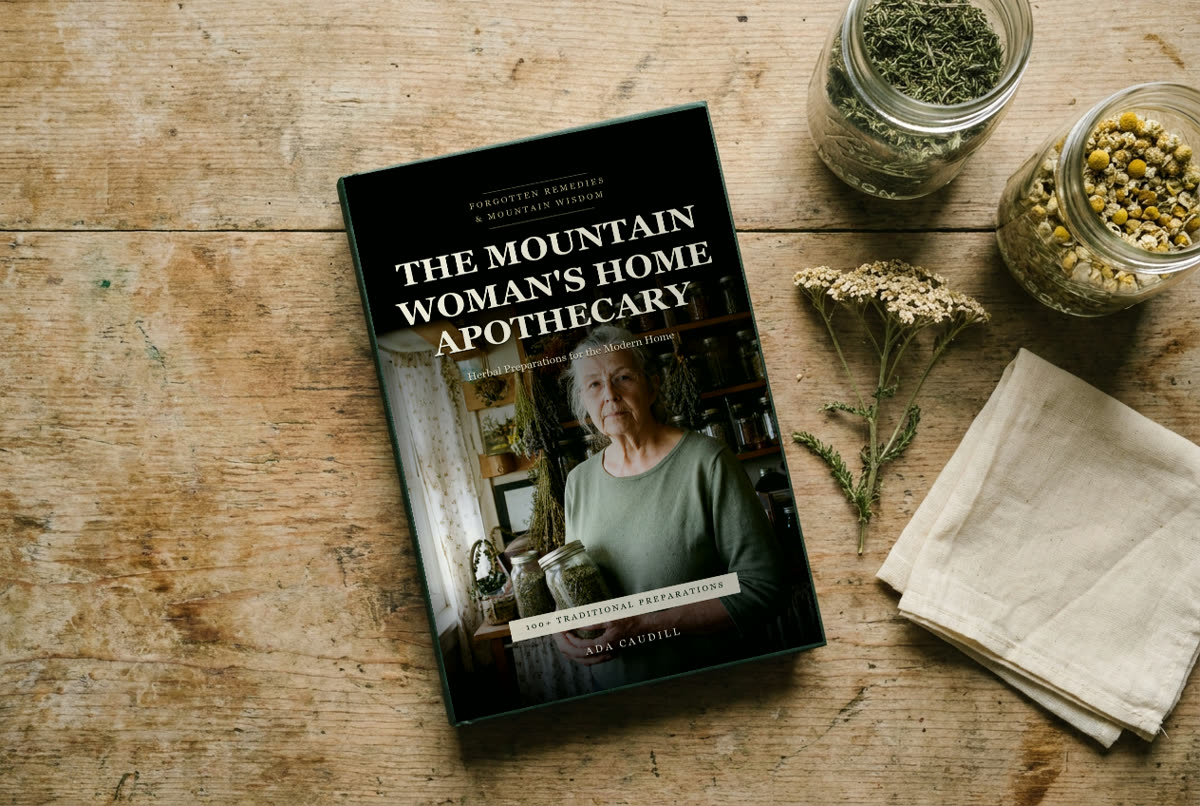
The Mountain Woman's
Home Apothecary

Forgotten Remedies, Herbal Preparations & Mountain Wisdom for the Modern Home

258 pages · 100 preparations · 30 herbs · 25 plants

My grandmother wrote it all down. The amount, the jar, the number of days, how you knew it was ready — and what it looked like when she had ruined it.

I nearly lost the whole thing in a drawer.

Get the Apothecary — $47

Instant download · PDF & printables · Yours to keep

Who was keeping this

Ada Caudill in her pantry, shelves of dried herbs behind her
Ada, on the ridge

My grandmother Nell was the granny woman for our hollow.

That is not a title anybody gave her. It is what you were called when the nearest doctor was forty miles of bad road and somebody had to know what to do until morning. She was not a physician and she never once said she was. She was the one who was there.

She kept a ledger. Pencil, leather cover, and she wrote in it from 1931 until the year she passed. Not a list of plants — anybody can list plants. She wrote the amount. The jar. The number of days. How you knew it was ready, and what it looked like when she had ruined it.

That last part fills more pages than the recipes do.

I watched her make most of what is in that book before I was twelve years old. Then I left this ridge for thirty years, the way people do, and I came back to an empty house and that ledger sitting in a drawer.

I have been copying it out ever since.

Why the last one you bought is still unopened

Most herb books tell you what a plant was for, and never how much.

"Make a poultice of plantain."

How much plantain. Fresh or dried. Chewed or crushed. On the skin, or inside a cloth. For twenty minutes or an hour. And what does it look like when it has gone wrong.

A woman who actually did this every week knew all six of those things without thinking. The books left them out because the writer did not know them either.

Then somebody fed all of those same thin books into a machine and sold you five hundred recipes with nobody behind them at all. You can tell. Everybody can tell.

None of this faded because it quit working. It faded because we quit doing it, and then somebody sold it back to us in a bottle with a label on it.

What is in it

Seven parts, in the order you actually need them

Part One

The Mountain Medicine Cabinet

Thirty things we kept close

Not a hundred herbs. Thirty, known completely — which is the difference between a collection and a practice.

Peppermint. Ginger. Chamomile. Elderberry. Mullein. Yarrow. Plantain. Dandelion. Nettle. Calendula. Lemon balm. Thyme. Rosemary. Sage. Garlic. Onion. Honey. Cider vinegar. Oats. Epsom salt. Cayenne. Cinnamon. Cloves. Mustard. Baking soda. Beeswax. Comfrey. Horehound. Catnip. Witch hazel.

Every one gets the same seven headings: what it is, what it was traditionally used for, how it was prepared, how to store it, how long it keeps, cautions and interactions, and a note of mine at the end.

Part Two

The Remedy Cabinet

Look up the situation, not the herb

Nobody stands in their kitchen at nine at night wondering which herb to use. They are thinking about a situation.

Thirteen categories — digestion, rest, the cold months, skin, aches, mouth and gums, head and eyes, hair, hands and feet, a woman's seasons, the sick room, the household year, and travel and hard work — each pointing you straight at the right pages.

Part Three

How Mountain Women Made Them

The twelve methods. This is the part that makes you competent.

Teas. Infusions. Decoctions. Herbal oils. Salves. Poultices. Compresses. Syrups. Vinegars. Baths. Gargles and rinses. Steams.

Each gives you the ratio, the vessel, the timing, the readiness test — and the failure modes, which is the part every other book leaves out.

Part Four

100 Traditional Preparations

Written out. All of them.

Grandma's Ginger Honey. Old-Fashioned Onion Cough Syrup. Elderberry Syrup. Calendula Skin Salve. Horehound Drops. Mountain Switchel. Fire Cider. The Old-Fashioned Oat Bath. Dandelion Root Coffee.

And eighty-eight more. Every one carries: You'll Need · How To Make It · How To Use It · How To Store It · Shelf Life · Safety Notes.

The shelf lives are honest, not optimistic. Where a thing keeps one week, it says one week.

Part Five

The Backyard Apothecary

Twenty-five useful plants hiding in plain sight

How to identify it. Where it grows. When it is harvested. Which part was used. How it was prepared and preserved.

And what it is confused with. The lookalike pages matter more than the rest of the section put together.

Part Six

Preserve the Harvest

So it is still good in February

Drying, hanging, screens and dehydrators. Storing. Freezing. Oils and vinegars. Labelling and dating. The master shelf-life table. How to tell when something has turned.

Part Seven

The Herbs You Shouldn't Guess With

The careful part

Pregnancy and breastfeeding. Children. Older adults. How herb and medicine interactions actually happen — the mechanism, so you can reason about things I never thought to include. Blood thinners. Sedatives. Blood-pressure medication. Allergies. Before surgery. The plants that are genuinely dangerous, and what they stand next to in a field.

My grandmother was not against doctors. There is a page in her ledger with no remedy on it. It says, this one is past me.

Mountain wisdom is not knowing a plant for every situation. It is knowing which situations are not yours.

Included

Five printable companions

The Medicine Cabinet Checklist

Building the shelf from nothing, in order. Herbs, oils, containers, equipment, storage. Pin it inside a cupboard door and tick it off over a year rather than a weekend.

30 Printable Remedy Cards

Four by six inches, one preparation each. Print them on card, put them in a recipe box, and keep the one you are using propped against the flour tin.

The Seasonal Mountain Calendar

Twelve months. What to gather, what to make, what to start now so it is ready when you need it.

The Pantry Quick Reference

One sheet. Every herb, the part used, the preparation, the storage, and the one caution that matters most.

Grandma's Measurement Guide

A pinch, a handful, a teacup, a gill. Every old word converted into something you can measure.

Everything you get

One payment. Yours to keep.

The Mountain Woman's Home Apothecary — 258-page reference guide
Included
100+ Traditional Preparations, written out in full
Included
30 Printable Remedy Cards
Included
The Mountain Medicine Cabinet Checklist
Included
The Seasonal Mountain Calendar
Included
The Herbal Pantry Quick Reference
Included
Grandma's Measurement Guide
Included
Everything$47
Get the Apothecary

Instant download · 30-day guarantee

Secure checkout Instant download 30-day guarantee

Forty-seven dollars is about what a family spends at the pharmacy in a bad week in February. It is less than one visit to anybody, and it is a single afternoon's work at most jobs in this county.

What you are actually buying is not a book. It is the part nobody wrote down — the amounts, the jars, the days, the tests, and the mistakes, from a woman who made every one of them and then wrote down what went wrong.

Once it is in your kitchen it is yours. Print it. Keep it in a binder on the shelf. It does not expire, it does not need a subscription, and nobody can take it back off you.

Thirty days. No hard feelings.

Read it. Make something from it. If it is not what I said it was, write to me inside thirty days and I will refund you, and you may keep the printables.

I would rather have your good opinion than your forty-seven dollars.

Before you decide

Questions people ask

I have never made anything like this. Is it too advanced?

Start at Part Three. Twelve methods, taught properly, with what to do when each goes wrong. Then make the ginger honey on the first page of Part Four — a jar, some honey, a piece of ginger, and a week of turning it over. If you can make a cup of tea you can make most of this book.

I don't have land, or a garden.

Neither do most people who use this. Twenty of the thirty ingredients in Part One come from a supermarket. Part Five covers plants that grow in sidewalk cracks and along fence lines, and Part One tells you honestly which things are worth your afternoon and which are better bought — witch hazel among them.

Is this a printed book?

It is a PDF, delivered the minute you buy it, made to be printed at home if that suits you better. Many people print Parts Three and Four and put them in a binder in the kitchen, which is what I would do.

What is actually in it about safety?

An entire part, and it is not buried at the back as an afterthought. Pregnancy, children, older adults, and the real mechanism behind medicine interactions rather than a vague warning. It is written so that you can reason about a plant I never thought to include.

Are you a doctor?

No, and I say so on every page that needs it. This book is history and craft. It is not medical advice, and nothing in it should change what your doctor has you taking. If you are on any prescription, ask your pharmacist before you add anything to it — including a tea. They will do it, it is free, and it takes them ten minutes.

Do I need special equipment?

A pan, some jars, a strainer, and a square of cloth. The one preparation that needs a candy thermometer says so on its page.

Ada Caudill talking to camera in her pantry

I could not fit what my grandmother taught me into those little videos.

So I sat down and put it all in one place. The herbs, the preparations, what we kept in the pantry, what time of year we gathered it, and the things you ought to be careful with.

She made me promise the old ways would not die with me. That is the whole of why this exists.

If you would like a copy, you will find my Mountain Woman's Home Apothecary just below.

Ada Caudill

Get the Apothecary — $47

Instant download · 30-day guarantee · Yours to keep and print